
You walk out after a hard stretch of July heat and the roof just looks off. A few shingle corners are turned up like a potato chip. One tab is sitting proud and you can see the shadow line under it. Then you notice a couple of little bumps that were not there last year, nail pops pushing the shingle up around the fastener.
A lot of homeowners in West Chester Township OH see this and assume it is hail or “bad shingles.” Sometimes it is. Most of the time, the roof is telling you something about heat, airflow, and how the shingles were fastened. Curling and nail pops usually start from underneath. The attic gets hot, the decking moves, the shingle mat gets cooked, and the fasteners are not holding the way they should.
The good news is you can usually trace the cause with a proper inspection. The fix is about details, not luck.
Attic heat loads bake the shingle from below
Asphalt shingles are built to live in the sun, but they are not built to be slow-cooked from both sides. On a clear summer day, shingle surface temps can run well over 160°F. If the attic is also running hot because it is not venting, that heat pushes up through the roof deck and into the back of the shingle.
That extra heat does two things. First, it accelerates asphalt oxidation. The shingle loses flexibility, then you start seeing edges and corners that do not relax back down after a cold night. Second, it drives more expansion and contraction in the decking. OSB and plywood move with temperature and moisture. When the deck cycles hard, nails can work loose over time.
We see this a lot on homes with blocked soffits, missing baffles, or an under-sized ridge vent. A balanced system matters. A common target is 1 square foot of net free vent area per 150 square feet of attic floor (or 1:300 in some conditions), split roughly half intake at the eaves and half exhaust at the ridge.
Ventilation that is “there” but not actually working
A ridge vent on the peak does not automatically mean the attic is vented. We run into plenty of roofs where the ridge vent is installed, but the slot cut is too narrow, or the vent is choked by old felt and nails. Same story at the eaves. You can have perforated soffit panels and still have no intake because the insulation is packed tight to the roof deck.
This is where the failure mode shows up as curling and lifted tabs. If the attic cannot pull cooler air in at the bottom, the ridge vent becomes a passive hole, not a draft. The heat sits up there all day, and the shingles take it.
A basic detail that gets missed is the baffle. We like to see a proper foam or cardboard baffle in every rafter bay, held up so you keep a clear 1 inch or more air channel from soffit to attic. Without that, blown insulation drifts and blocks the intake.
Another detail is bathroom fans. If a bath fan dumps moist air into the attic instead of out through a roof cap or wall cap, you get wet sheathing in winter. That swelling and shrinking can help start nail pops.
Nail pops: fastener choice and placement matter
A “nail pop” is usually not the nail rising by itself. It is the deck moving, the nail not biting enough wood, or the shingle being held up by a fastener that was not seated right.
Fasteners should be roofing nails, not staples. We use nails with a broad head, typically around 3/8 inch, and length that actually penetrates the deck. The rule of thumb is the nail should go through the shingle and underlayment, through the deck, and extend about 1/4 inch past the underside of the sheathing. On a roof with 7/16 inch OSB, that usually means a 1 1/4 inch nail. If there is a second layer of shingles, or thicker deck, that changes.
Placement matters just as much. Nails have to land in the manufacturer’s nail line, not high and not low. High nails miss the double-layer reinforcement and can let tabs lift. Overdriven nails cut into the mat and reduce holding power. Underdriven nails hold the shingle up and create a bump that catches wind.
If we find widespread pops, we look for patterns. Same row, same slope, same day’s work. That points to install technique.
Underlayment and deck movement show up as curling
Curling is not always a “bad shingle” problem. Sometimes the shingle is reacting to what it is sitting on. If the deck is uneven, swollen, or delaminating, the shingle will telegraph it.
OSB that has taken on moisture can swell at the panel edges. You see a ridge at the seams, then shingles above it can tent and curl as they age. Plywood can do it too, but OSB edge swell is common when ventilation is poor or when there have been roof leaks around pipe boots and valleys.
Underlayment plays a role. Synthetic underlayments are tough, but they are slick. If the shingles were installed on a hot day and the crew did not keep courses straight and tight, you can get slight bridging that never settles. Traditional asphalt-saturated felt tends to lay flatter, but it can wrinkle if it gets wet and then covered, and those wrinkles can translate into raised lines under shingles.
We also check the drip edge and starter course. A proper metal drip edge at eaves and rakes, lapped correctly, helps keep water from wicking back into the deck edge. Wet deck edges move more. Movement is what loosens fasteners and curls shingles over time.
Wind lift finds the weak spots, then makes them worse
Once a tab is lifted, wind does not politely leave it alone. It works it back and forth. That pumping action breaks the seal strip bond and stresses the nails.
Most laminated shingles rely on a factory-applied sealant strip that activates with heat. If the shingle never sealed because it was installed late in the season, or because dust and pollen were heavy, you can end up with tabs that are easy to lift even at 30 to 40 mph gusts. West Chester Township sees those spring and fall wind days where the trees are moving but it is not a storm. That is enough to start trouble on an unsealed roof.
Details that matter here are starter strip and edge fastening. At the eaves and rakes, we want the starter course installed correctly, adhesive at the right edge, and the first course nailed in the right zone. If the rake edge is missing drip edge or has a loose metal edge, wind can get under the shingle line.
If we find lifted tabs, we also look at the sealant. If the seal strip is contaminated or never bonded, hand-sealing with approved roofing cement can be part of a repair, but it is not a substitute for getting the ventilation and fastening right.
Seasons and timing: why problems show up after summer and after freeze-thaw
Homeowners often notice curling in late summer, then notice nail pops in late winter. That timing makes sense.
Summer heat is when the shingle bakes and loses flexibility. That is when you see corners that stay up. It is also when attic temps spike if intake is blocked. If the roof deck is running hot and dry, fasteners can loosen slightly as the wood cycles.
Then winter comes. Moisture levels change. You get freeze-thaw cycles where daytime temps climb above 32°F and nights drop below. If the attic is leaking warm, moist air from the house, that moisture condenses on the underside of the deck. Wet wood swells. When it dries, it shrinks. That movement is hard on nails.
Ice damming is another piece. If insulation is uneven and ventilation is weak, the roof warms above the eaves, snow melts, then it refreezes at the cold edge. Water backs up. Even a small backup can wet the deck edge and starter area.
A proper inspection looks at the roof and the attic. We check for frost on nails, darkened sheathing, and compressed insulation at the eaves. Those are all checkable signs that explain why the shingles are moving.
What our inspection looks at, and what we fix so it stays fixed
A real shingle curling West Chester Township OH inspection is part roof surface, part attic diagnostics. From the roof, we mark where curling is concentrated. Is it the south slope only. Is it near valleys. Is it scattered around plumbing vents. Patterns matter.
From the attic, we measure ventilation and look for blockage. We check soffit intake, baffles, and the ridge slot. We also look at the deck itself. 7/16 inch OSB that is spongy, dark, or swollen at seams is a red flag. We look at fasteners too. If nails are shiny and backed out, that is often movement. If nails are rusty, that points to moisture.
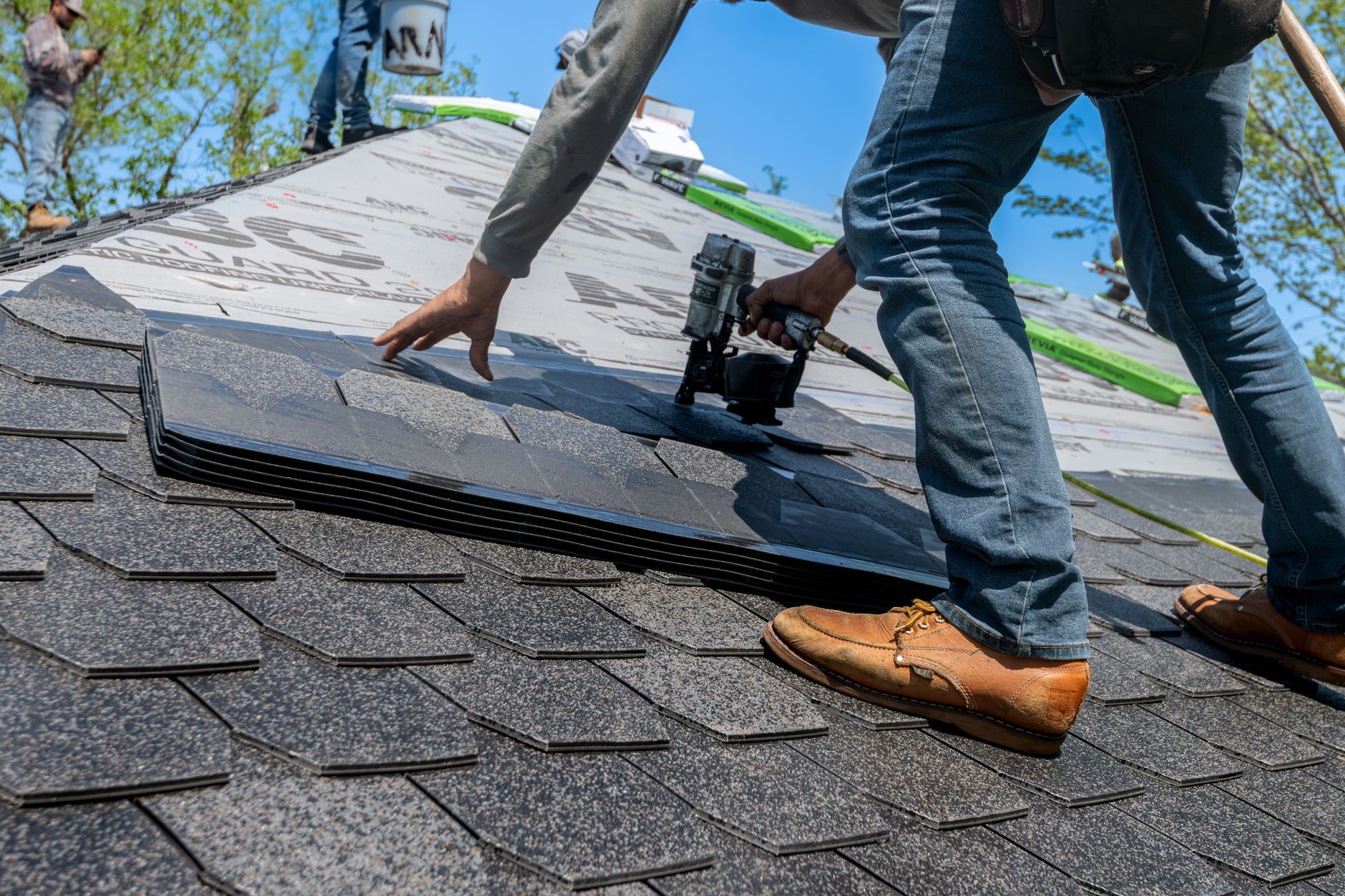
On repair work, we do not just push a shingle down and walk away. We reset or replace popped nails, then seal the shingle properly. We replace failed pipe boots and cracked vent flashings. If the roof is at the point where the field shingles are brittle and curling across multiple slopes, that is usually a replacement conversation.
On replacement, we build the system. Proper underlayment, proper starter, metal drip edge, correct nail pattern, and ventilation that is actually balanced. That is how you stop the same complaint from coming back in two seasons.
Key Takeaways
- Attic heat can push shingle temps past 160°F and accelerate curling from the underside.
- Balanced ventilation targets about 1:150 net free vent area (or 1:300 in some cases), split intake at soffits and exhaust at ridge.
- Nail pops often trace to high nails, overdriven nails, or nails too short to extend about 1/4 inch past the deck.
- OSB edge swell and wet deck edges can tent shingles and loosen fasteners over time.
- Unsealed tabs let 30 to 40 mph gusts work the shingle back and forth until the seal strip fails.
Conclusion
Curling shingles and nail pops are usually a system problem. The roof is telling you it is running hot, breathing wrong, or not fastened the way the manufacturer intended. If you catch it early, some roofs can be stabilized with targeted repairs, ventilation corrections, and flashing work. If the shingles are brittle and the lifting is widespread, we start talking replacement, because you cannot make an aged shingle lay flat again.
If you are seeing lifted tabs or bumps on the roof in West Chester Township OH, get a full inspection that includes the attic. We will tell you what is driving it on your house, then lay out the fix that holds through the next summer and the next freeze-thaw cycle.


